
As a former strategy consultant and an early adopter of AI technologies as an entrepreneur, I have often been asked what kind of “AI strategy” companies need to develop and implement. It’s a serious question, for several reasons.
LLM-driven AI is…
- a genuinely disruptive technology. Its applications to natural language processing, knowledge management, data stewardship, code generation, etc. are already very significant;
- a rapidly developing, incredibly young technology. The first meaningful paper outlining LLMs as a potential is from 2017. GPT-3 was launched in June 2020;
- a “platform” technology, upon which one can build sophisticated workflows and remarkable solutions.
However, for all its power, it remains a tool.
Let’s get back to the basics
Remember the good old Strategy Choice cascade? When I was at Monitor Group, we used it all the time with clients (here is a good refresher).
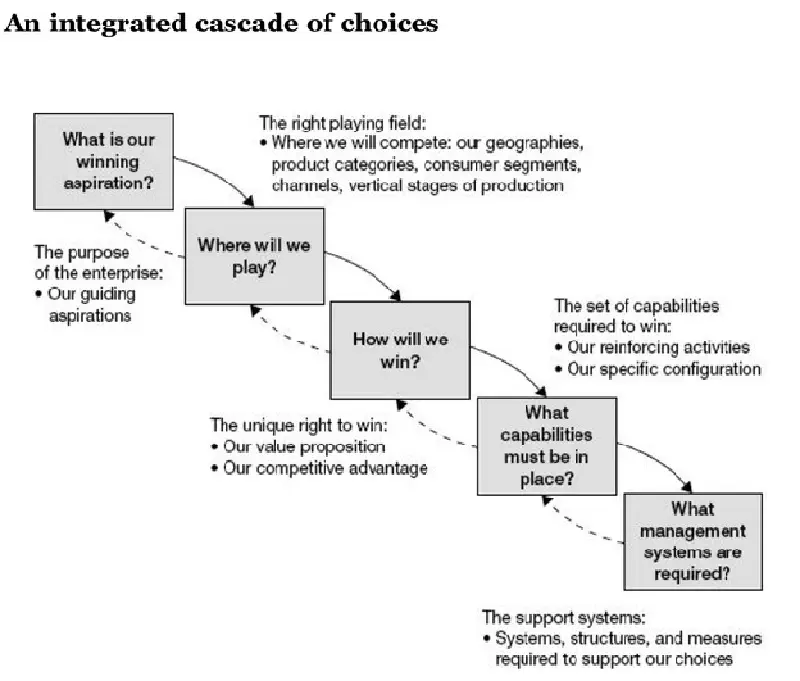
(I must have worked with dozens of clients to help them think through, pressure-test, and formalize these choices—but that’s a story for another time).
Now, here’s the deal.
Unless you’re working in a tech firm, or starting up a company—AI belongs in the “support systems” set.
Will the existence of AI…
- Alter your company, or your BU’s, goals and aspirations?
- Open up new market segments, or make you shift your prioritization and targeting?
- Create a meaningful source of competitive advantage (be honest here)?
Probably not.
So, does it mean we can ignore it?

Nope. It means you need an adoption plan, not a strategy.
Why is this different? An adoption plan…
- is based on your current processes;
- looks at the tasks that those processes are comprised of;
- involves incremental, deliberate transformation to improve performance.
AI is a matter of operations, not of strategy. Its importance is hard to overstate; however, for companies to successfully embrace it, it must be positioned in the right way to internal teams and investors alike.
Originally published on LinkedIn in May 2024.